
Why stored diesel degrades
Conventional diesel storage tanks are not sealed environments. Heat, stagnancy and moisture work continuously against the fuel your continuity plan depends on.
01 — The risk
What building & facility managers need to know
Conventional diesel storage tanks are not sealed environments. Heat, stagnancy and moisture work continuously against the fuel your business continuity plan depends on.
The onus sits with you. Generator manufacturers demand clean fuel per ASTM D975 and ISO 4406 — responsibility for meeting that falls on the building owner or facility manager.
-
A
Performance impact
Poor fuel quality directly undermines your business continuity plan, operational reliability and generator performance.
-
B
Technical risks
Water contamination, microbial growth and fuel degradation clog filters and can cause engine failure — a heavy OPEX hit in repair costs.
-
C
Compliance
A structured approach with frequent reviews of your emergency fuel policies keeps them aligned with real operational needs.
-
D
The solution
Regular monitoring and scheduled maintenance — sampling, testing and polishing — keeps fuel in top condition without taking the tank offline.
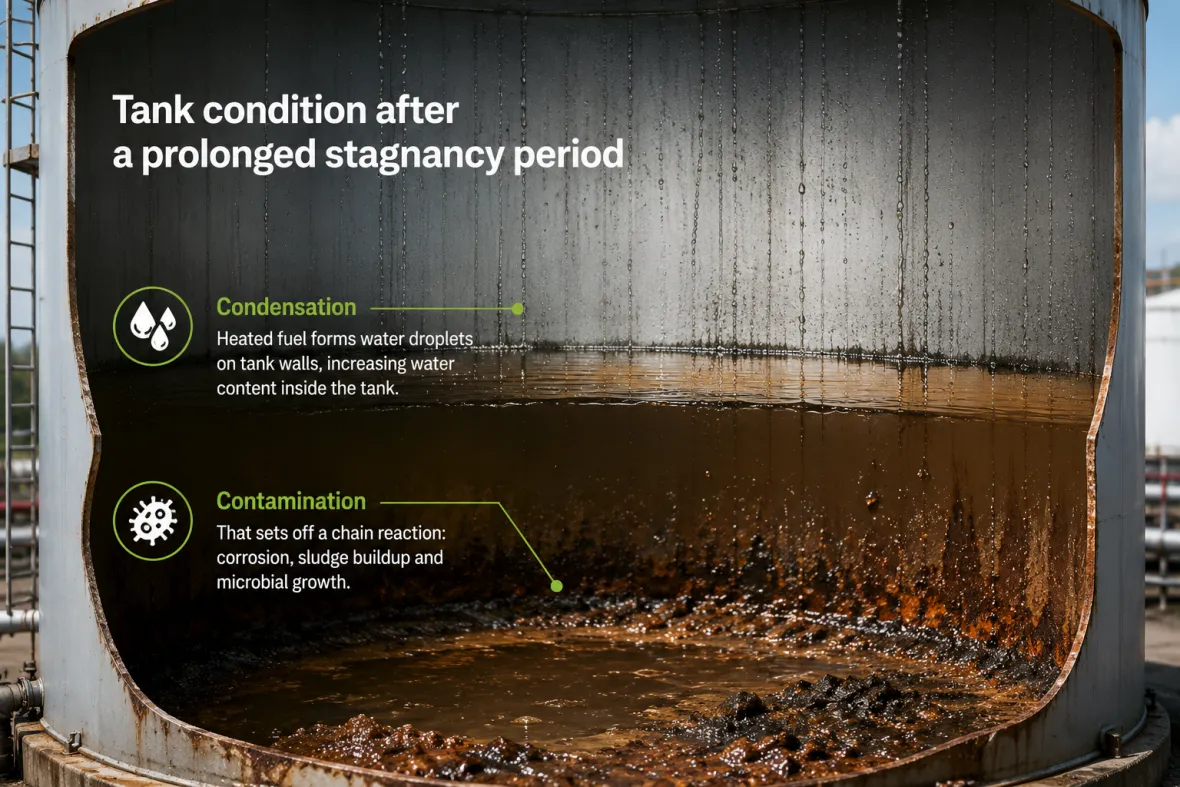
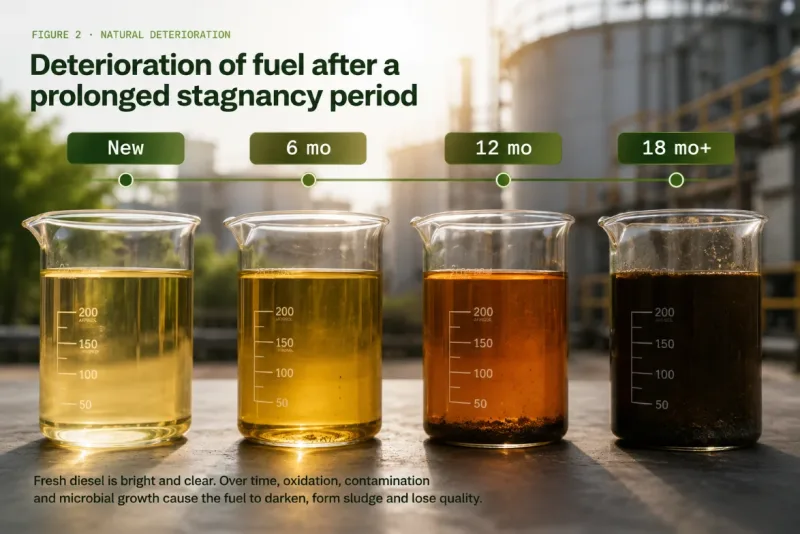
Figure 2 · Natural deterioration
Deterioration of fuel after a prolonged stagnancy period
Fresh diesel
Bright, clear, straw-coloured fuel meeting ASTM D975 on water, sediment and particulates.
Early degradation
Colour deepens as oxidation begins. Water content rises from tank-wall condensation.
Contaminated
Visible haze and suspended solids. Microbial growth and sludge start clogging filters.
Failed fuel
Dark, opaque and heavily degraded — a direct engine-failure risk when the generator is called on.
Find out what condition your stored diesel is in
Book a fuel quality inspection and you will know where you stand — sampling, independent lab testing and a written certificate of analysis, with the generator available throughout.