
Diesel fuel reconditioning and polishing
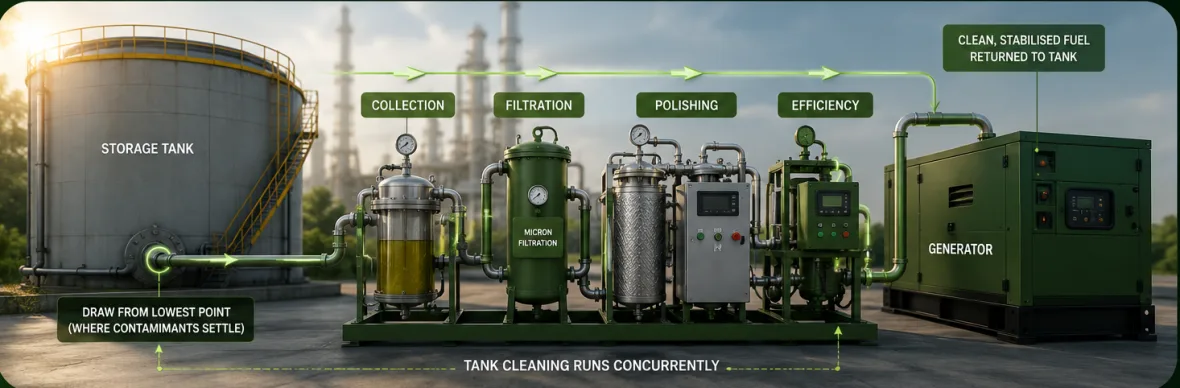
Fuel is drawn from the lowest point of the tank, filtered, polished and stabilised, then returned — while tank cleaning runs concurrently.
02 — Our solution
Diesel Fuel Reconditioning Services
Fuel is drawn from the lowest point of the tank, filtered, polished and stabilised, then returned — while tank cleaning runs concurrently. The generator stays available throughout.
-
01
Collection
Stored diesel is suctioned from the bottom of the tank, where most contaminants deposit.
-
02
Filtration
Macro-sized contaminants — water, organic waste, sludge — are filtered out first.
-
03
Polishing
Filtered diesel is polished to eliminate micron-sized particles and stabilised while tank cleaning runs.
-
04
Efficiency
Fuel never leaves the storage tank, ensuring zero downtime for generators during the process.
03 — Operational framework
Our procedure
Every engagement starts with evidence. Sampling and testing decide the route — routine monitoring or full reconditioning.
Proposed maintenance schedule
| Service | Frequency | Key criteria |
|---|---|---|
| Fuel quality inspection, testing and sampling | 3–6 months | Water level, microbial growth, degradation and sludge |
| Fuel polishing and tank cleaning | 6–12 months | Water level, microbial growth, degradation and sludge |
Find out what condition your stored diesel is in
Book a fuel quality inspection and you will know where you stand — sampling, independent lab testing and a written certificate of analysis, with the generator available throughout.